Sometimes a tree is worth saving but has a structural weakness, such as a split-prone union where two stems meet or a heavy limb that could fail. Cabling and bracing are support systems that help stabilize these weak points so the tree can be kept safely.
Cables are installed high in the canopy to limit the movement of weak branches or stems, reducing the stress that could cause them to fail. Bracing rods provide more rigid support across a split or weak union. Together, they can extend the safe life of a valued tree.
These systems are not a substitute for good structure, but for the right tree they offer a way to reduce risk without resorting to removal. We will tell you honestly whether support makes sense for your tree.
What to Expect
Cabling and bracing are appropriate when a valuable tree has a weak attachment or heavy limb that can still be supported. Before installation, we inspect the union, branch loading, canopy balance and any signs that the defect is already advanced. That evaluation matters because support hardware is useful only when the tree still has enough sound structure to work with.
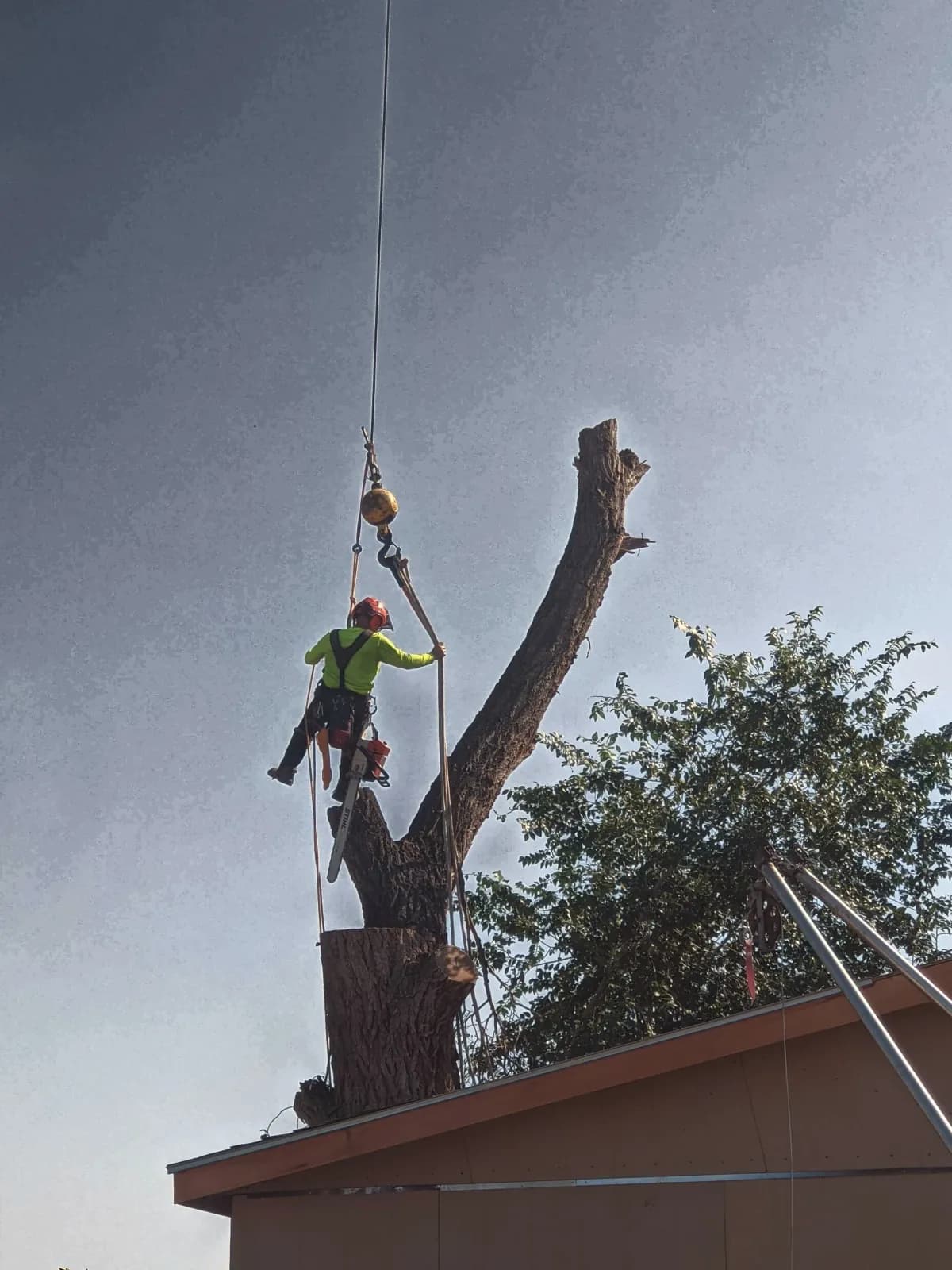
The service includes design and installation of the hardware, but it does not eliminate all future risk. Cables reduce excessive movement at the weak point and braces reinforce a split or vulnerable union, yet the tree still needs periodic monitoring. Access into the canopy, ladder or climbing work and nearby property features all influence how the system is installed and whether it is a sensible choice in the first place.
If a tree is too compromised, support may not be the right answer and removal may be safer. For some trees, pruning can reduce weight and make the support system more effective. We work throughout Grand Junction and the Grand Valley, and we offer free estimates so you can decide whether preservation is worth the investment.
Support hardware is best viewed as one part of a broader plan. A tree with a weak union may still need annual checks, pruning to control load and occasional reassessment as it grows and the supported area changes. That is normal. The value of support is not in pretending the defect disappeared, but in giving a good tree a more stable path forward when removal would be premature or unnecessary.
This approach works best when the tree has a clear reason to be preserved, such as shade value, specimen character or a landscape role that would be hard to replace. If those benefits are limited, it may be smarter to invest in pruning or removal instead of hardware. We will walk through that tradeoff so the recommendation is tied to what the tree contributes and what it will likely need later.
What's Included
- Evaluation of structural weak points
- Cable installation to limit movement
- Bracing for splits and weak unions
- Combined support systems where needed
- Recommendations on ongoing monitoring
- Honest advice on whether support is worthwhile
Our Process
- 1
Evaluate structure
We identify the weak union or limb and judge whether support is appropriate.
- 2
Design the system
We determine the right combination of cables and bracing for the tree.
- 3
Install carefully
We install the hardware using sound technique to support the tree.
- 4
Advise on monitoring
We recommend periodic checks to keep the system effective.
Why Choose Top Notch Trees
Preserve valued trees
Support systems can save a tree that would otherwise need removal.
Reduced failure risk
Cables and braces limit movement and stress at weak points.
Targeted solution
Support addresses a specific weakness rather than the whole tree.
Honest evaluation
We only recommend support when it genuinely makes sense.
If you have a valued tree with a structural weakness, support may be an option. Reach out for a free estimate and we will assess whether cabling or bracing is right for your tree.