Frequently Asked Questions
Tree Service Questions, Answered
Straightforward answers about how tree work is scoped, what to expect on site and how to get a free estimate in the Grand Valley.
There is no flat rate because every tree and property is different. Cost depends on the size and species of the tree, its condition, how close it is to structures or power lines, how difficult the access is and whether specialized equipment like a crane is needed. Scope matters too, since a simple trim is very different from a full removal with stump grinding and haul-away. The most accurate way to get a number is a free estimate based on the tree and site conditions.
Yes. We provide free estimates for tree work throughout Grand Junction and the Grand Valley. You can request one through the form on our contact page or by calling us directly. For most jobs we prefer to look at the tree in person so the estimate reflects the real conditions.
Yes. Top Notch Trees is licensed, bonded and insured. That protects you as the property owner and it is a basic thing worth confirming with any tree company before work begins, especially for removals near homes and utility lines.
Yes. ISA Certified Arborist knowledge guides how we evaluate tree health, decide between pruning and removal and identify structural concerns. Certification means training in tree biology and accepted care practices, which leads to recommendations based on the tree rather than guesswork.
We serve Grand Junction and communities across the Grand Valley, including Fruita, Palisade, Loma, Mack, Clifton, Orchard Mesa, the Redlands and Fruitvale. Availability for a specific project can depend on scope and location, so it is best to reach out and ask.
Yes. We offer 24/7 emergency tree service for situations that threaten people or property, such as a tree on a house, a large fallen limb blocking access or a trunk that has split. Call us and we will talk through the situation and what can be done.
An emergency is anything where a tree or limb is an immediate safety concern. That includes trees or large limbs that have fallen on a home, vehicle or across a driveway, trunks that have split, limbs hanging over an area people use and trees leaning sharply toward a structure after a storm. If someone could be hurt or property is at risk right now, treat it as an emergency and call.
Some common signs include large dead sections, a sudden lean with soil lifting at the base, deep cracks in the trunk, major limbs that have already failed, extensive fungal growth at the base and roots that are damaged or decayed. One sign alone does not always mean removal is required, which is why an assessment matters. Sometimes pruning or a support system is enough, and sometimes removal is the safer choice.
Often, yes. Not every damaged tree needs to come down. Storm damage, a broken limb or minor decay can sometimes be managed with proper pruning, cleanup or cabling and bracing. We look at the location, the extent of the damage and the overall structure before recommending removal. When a tree can be kept safely, we will tell you.
The words overlap in everyday use, but there is a useful distinction. Trimming usually focuses on clearing and shaping, such as cutting back limbs away from a roof, driveway or power line and keeping the canopy tidy. Pruning is more about the long-term health and structure of the tree, using selective cuts to remove deadwood, improve form and reduce future problems. Both have their place and we handle each.
No. Topping, which means cutting main limbs back to stubs, is not a practice we recommend. It stresses the tree, invites decay and produces weak regrowth that can become hazardous later. When a tree is too large or crowding a space, proper reduction pruning or removal is a better answer than topping.
For many trees the dormant season in late winter is a good time to prune because the structure is easy to see and the tree responds well in spring. That said, dead, broken or hazardous limbs can be removed at any time, and some species have their own timing preferences. If you are unsure, ask and we can advise based on the tree.
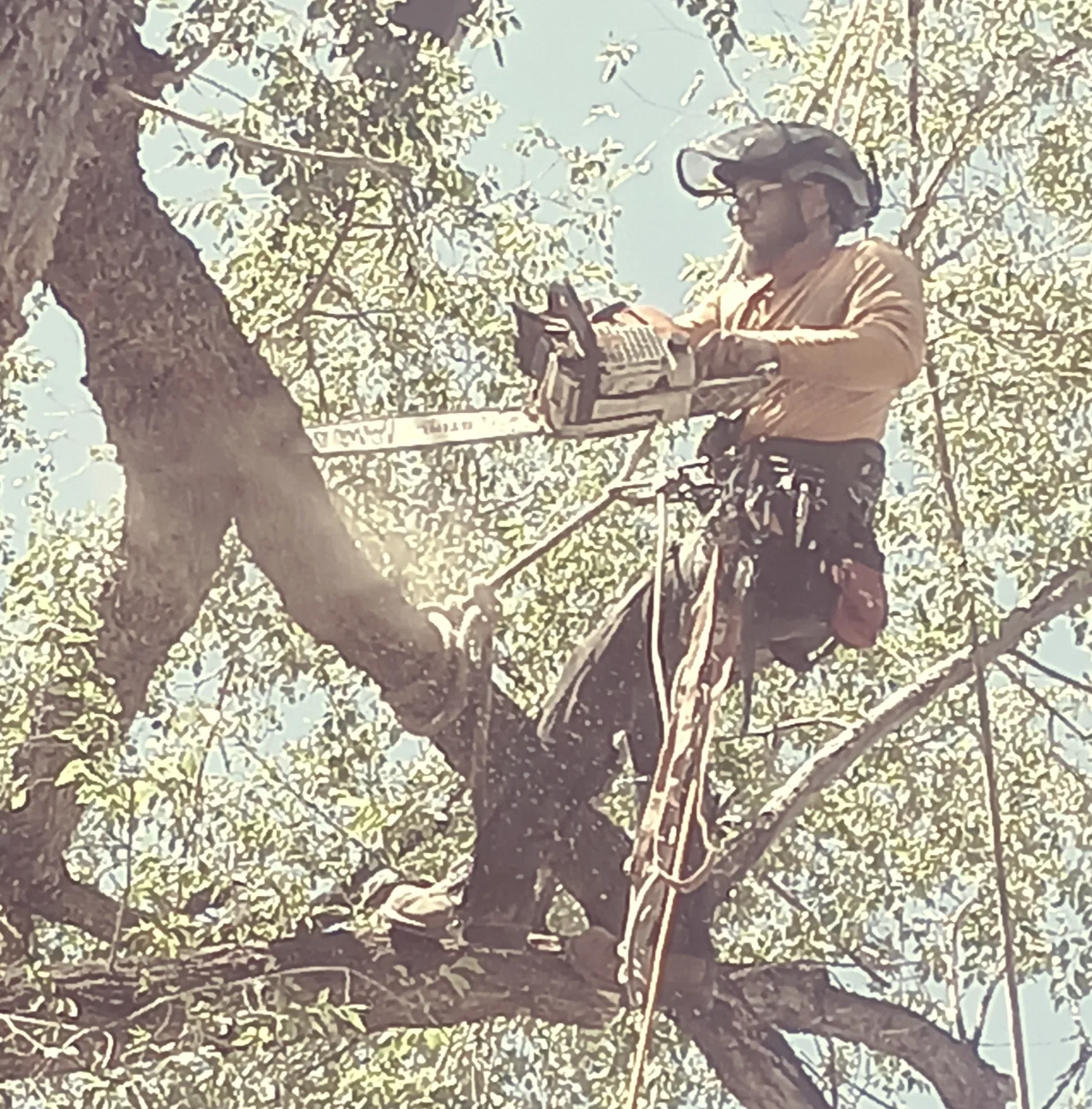
Yes. High-risk removals are a core part of what we do. That includes large trees, dead or unstable trees, trees in tight spaces and trees close to homes and other structures. We use controlled rigging to bring material down in sections rather than dropping whole trees where that would be unsafe.
We can arrange crane-assisted removal when a job calls for it, such as very large trees or removals where there is no safe way to lower material by hand. Not every removal needs a crane, and we will only recommend one when it genuinely makes the work safer or more practical.
As part of most jobs we clean up the work area and haul away branches and debris. Wood and chips can often be handled based on what you prefer, whether that is removal from the property or leaving usable wood behind. We will go over the cleanup plan as part of the estimate so there are no surprises.
Stump grinding is usually a separate line item rather than automatic, because some owners want the stump gone and others plan to keep it. When you request a removal estimate, let us know if you want the stump ground down and we will include it.
Stump grinding uses a machine to grind the stump down below ground level, which reclaims the surface space and clears the visible stump while leaving the deeper roots in place to break down over time. Full stump removal takes out the stump and major roots, which disturbs more ground but fully clears the area for construction or replanting. Grinding is faster and less invasive, while full removal makes sense when you need the ground completely open.
Once the trunk and canopy are gone, most trees cannot keep growing because the leaves that fuel growth are gone. Some species can send up suckers from remaining roots for a while, but the root system generally stops expanding and slowly decays. If regrowth is a concern for a specific species, mention it and we can talk through options.
In many cases, yes, though it helps to grind the stump well and address the leftover wood chips and any remaining roots first. Fresh chips can tie up nutrients as they break down, so soil may need attention before replanting in the exact spot. We can talk through what would work for your yard.
Fire mitigation focuses on reducing the fuel that lets fire spread toward structures. Typical work includes creating defensible space around buildings, reducing ladder fuels that carry fire from the ground into tree canopies, removing deadwood, selective thinning of dense stands and clearing brush. We tailor the work to the property and often chip or haul away the material we remove.
Yes. We work with commercial properties, HOAs, property managers and multifamily sites in addition to homes. That includes one-time projects and scheduled maintenance to keep trees on a property safe and presentable.
We can perform tree work near utility lines with appropriate care, but there are limits. The space very close to power lines is controlled by the utility for safety reasons. For trees touching or extremely close to primary power lines, we recommend contacting your utility first, since that clearance work often falls to them. We are glad to advise on what applies to your situation.
Permit requirements vary and can depend on your property type, location and whether an HOA or local rule applies. We do not provide legal advice on permits. For anything you are unsure about, check with the City of Grand Junction, Mesa County or your HOA before removal so you have the correct answer for your property.
We can document the tree work we perform and provide the details you would typically need to share with an insurer, such as a description of the damage and the work done. We cannot promise how a claim will be handled, since coverage decisions are up to your insurance company. Keeping photos and records of the damage is always a good idea.
The quickest ways are to call us or to fill out the estimate form on our contact page. Tell us the location, what you are seeing with the tree and any access details, and add photos if the form allows. We will follow up about a free estimate.
Keep Exploring
Get a Free Tree Service Estimate
Tell us what is going on with your trees and we will set up a free estimate. For an active hazard, call and we will talk through next steps right away.